There is an image that I keep coming back to. Virat Kohli, on his knees, head bowed to the turf at the Narendra Modi Stadium, tears streaming down his face as the weight of eighteen years finally lifted off his shoulders. Around him, Rajat Patidar and the boys are sprinting, hugging, screaming into the Ahmedabad night. Somewhere in the stands, a billion hearts collectively exhale. RCB had done it. After three lost finals, after a decade of memes, after "Ee Sala Cup Namdu" had become less a rallying cry and more a running joke, Royal Challengers Bengaluru had actually, finally, impossibly won the Indian Premier League.
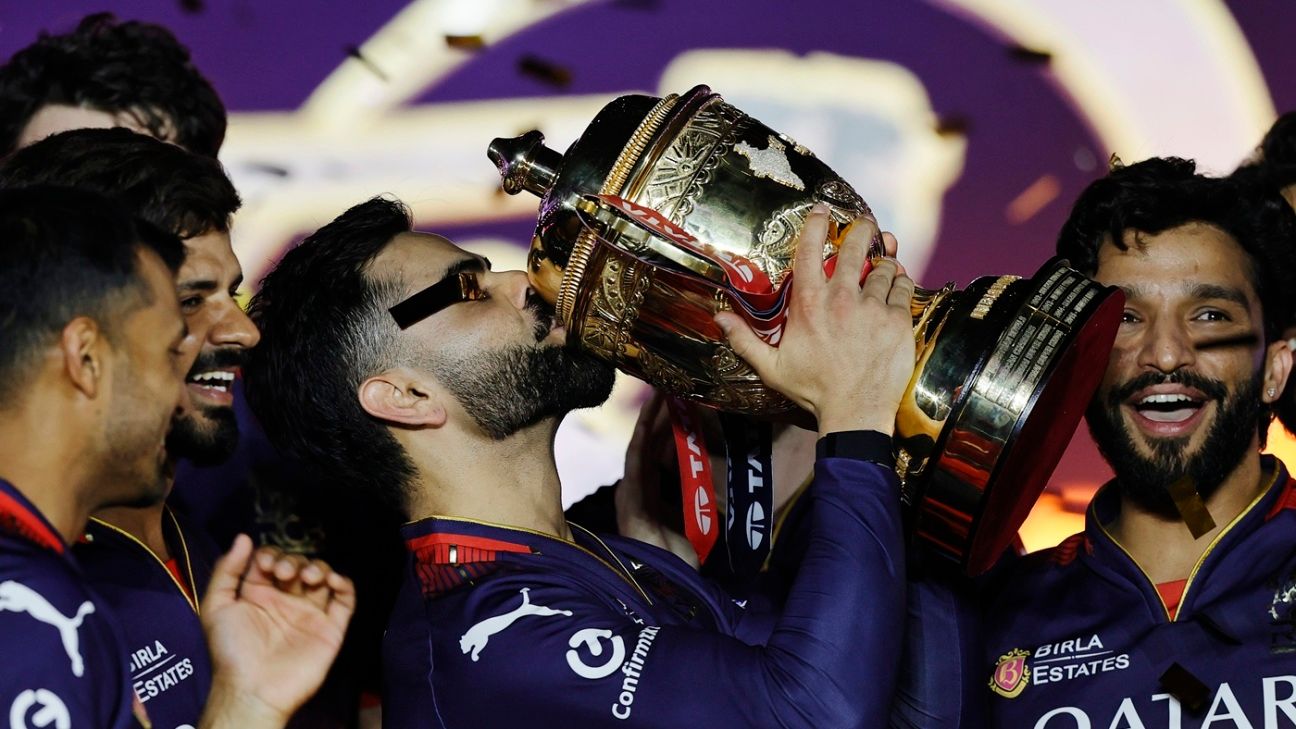
I remember watching the final. I was in New York, much to my manager’s perception, “working diligently on my project” and listening to what he thought was a podcast. All I could do was listen to the commentary as Josh Hazlewood delivered the last over. Punjab Kings needing 29 off the last over, and Josh Hazlewood delivering two dots to start. Two deliveries that separated history from heartbreak. Shashank Singh smashed 20 off the remaining four balls, but it was too late. The damage, as they say, was already done. The margin was six runs. It could have been six hundred. For an RCB fan, that trophy was a lifetime in the making.
But here is the thing about fairytales. They end. And history, the cold and unforgiving kind, suggests that what comes after the fairytale is rarely as pretty. Mo Bobat famously in the dressing room set the ambitious goal of defending the title, stating it has only happened twice before, and confident that it was going to happen again. I would love to believe in this tale of woe, and I do - but as a man of science, it’s hard to state with conviction that it will.
The reasons are structural, not mystical. T20 cricket is the most volatile format in the game. A season’s worth of momentum can evaporate in two bad powerplays. Squads shift. Opponents adjust. The hunger that drives a team chasing its first title is not the same hunger you carry when you are defending one. And in a league this stacked, with this many quality players spread across ten franchises, the margins between champions and also-rans are thinner than a Bumrah yorker at the death.
RCB’s 2025 season was extraordinary by any measure. They finished second in the league stage with nine wins, four losses, and an abandoned match. They became the first IPL team in history to win all their away games in a single season. Kohli finished with 657 runs. Hazlewood took 22 wickets. But what made that squad special was not just the star power. It was the depth. Krunal Pandya’s spell in the final, two wickets for 17 in four overs, was the kind of performance that turns a good team into champions. Jitesh Sharma’s ten-ball 24 pushed RCB past 190 on a tricky surface. Bhuvneshwar Kumar, Yash Dayal, Romario Shepherd, all of them had moments where they turned matches on their heads.
It’s teams like this, where every player could very well be player of the match that drives success over a season. It’s not Virat Kohli accounting for 40% of the teams’ runs like it did in 2016, it’s not Bumrah ensuring that what India needs to score in 20 overs, opponents need to achieve in 16. It's a team first mentality. The question now is whether that depth holds. And whether the intangibles that made 2025 magical can be manufactured a second time.
How much of the magic stayed
RCB retained seventeen players from their championship squad, the kind of continuity that looks smart on paper. You keep the core, you keep the chemistry, and you trust that the same group of men who climbed the mountain together can do it again. Patidar remains captain. Kohli remains the heartbeat. Hazlewood remains the spearhead. Andy Flower remains in the coaching box.
But continuity is a double-edged sword. The same players who were hungry underdogs in 2025 walk into 2026 as the team everyone wants to beat. The opposition has had an entire offseason to study RCB’s patterns, to decode Hazlewood’s death-bowling variations, to find the gaps in Pandya’s lines. Last year, RCB surprised people. This year, surprise is not on the menu.
The additions at the mini auction were measured rather than splashy. Venkatesh Iyer, brought in for seven crore, gives them a left-handed batting option and a sixth bowling choice. Ravi Bishnoi, had he not gone elsewhere, would have given them the wrist spin they have historically lacked. But the broader picture is clear: RCB is banking on the same formula that won them the title.
Let me tell you what I think is the hardest part about defending a title, and it has nothing to do with tactics or team composition. It is the shift in identity. Last year, RCB were the lovable losers who finally got their moment. The entire narrative of their 2025 campaign was built on catharsis. Kohli’s eighteen-year loyalty being vindicated. A fanbase that had suffered longer than any other in the IPL finally getting their payoff. The whole country, including rival fans, was quietly rooting for them by the end.
That narrative is gone now. You cannot be the underdog when you are wearing the crown. You cannot play with the freedom of having nothing to lose when you are the team with everything to defend. And in the IPL, where the mental game is half the battle, that shift in psychology is seismic.
Consider what Kohli himself said after the final. He described the win as being "right up there" with anything he had achieved, including World Cups. He talked about giving RCB his youth, his prime, and his experience. He was visibly overcome, tears flowing, voice cracking. It was beautiful. It was also, unmistakably, the sound of a man who had reached a summit he had been climbing for two decades. And that is what worries me. Not about Kohli’s commitment. The man does not know how to give anything less than everything. But about whether the emotional fuel that powered RCB through 2025 can be replenished. Hunger is not a renewable resource. Once you have eaten, the appetite changes. It does not disappear, but it transforms into something quieter, something less desperate. And desperation, as uncomfortable as it is, has always been RCB’s superpower. It was part of the reason I began supporting RCB way back when - the attitude, the mindset, the unforgiving nature to wear your heart on your sleeve and aggression in your eyes.
The Opening night question
For the first time, in franchise history, RCB walks into an IPL as champions. March 28. Chinnaswamy Stadium. RCB versus Sunrisers Hyderabad. On paper, it is the opening fixture of IPL 2026, the nineteenth edition, now expanded to 84 matches. In practice, it is something far more layered. It is the defending champions returning to a ground scarred by tragedy, against a team that provided said tragedy.
It is Kohli, now firmly in the twilight of his IPL career, walking out one more time to prove that last year was not a fluke. It is Patidar, the quiet captain who let his team do the talking, trying to establish that his leadership was not a one-season wonder. On the other side, SRH bring Travis Head and Heinrich Klaasen, two of the most destructive players in world cricket internationally. Ishan Kishan, fresh off a phenomenal T20 World Cup where he was among India’s most prolific run-scorers, captains the side in Cummins’ expected early absence. And of course, Abhishek Sharma who will very validly have a chip on his shoulder off of being thoroughly supported until the T20 world cup final. This is not a gentle opening fixture. This is a statement game for both sides.
And the broader picture is no less daunting. The 2026 IPL is stacked in a way that few previous seasons have been. KKR have spent over 60 crore to rebuild around Cameron Green and Matheesha Pathirana. CSK have Sanju Samson, the T20 World Cup’s Player of the Tournament, walking in with the kind of form that makes bowlers lose sleep. Mumbai Indians have an embarrassment of riches with Rohit, Suryakumar, Bumrah, and Hardik Pandya all under one roof. Punjab Kings, the team RCB beat in last year’s final, have retained 21 players and carry the fury of unfinished business. And I would be lying if I said Shreyas Iyer doesn’t worry me in the context of cricket.
The league is deeper, longer, and more competitive than ever. And RCB must navigate all of it with a target on their backs.
So can they do it?
As a fan, my answer remains yes. It was yes the year they came last, it was yes the year we came second, and it was yes last year. It unequivocally will continue to remain a resounding yes.
Here is my honest take, and I write this as someone who watched Kohli on his knees in Ahmedabad with a lump in his throat. I think RCB will make the playoffs. The core is too talented, the coaching setup too stable, and the squad too deep for them to fall off entirely. Patidar’s calmness under pressure and Kohli’s refusal to accept mediocrity will keep them competitive through the league stage.
RCB will face more struggles than they did last year. Not because they are not good enough, but because the IPL does not reward repetition. It rewards reinvention. And RCB, by design, have chosen continuity over reinvention this year. That is a reasonable bet, perhaps even the right one. But it is a bet that assumes the same formula works when every variable around it has changed. Only time will tell how much reinvention they have done over the course of this offseason. I hope, and I believe, they have.
But the sequel is rarely as good as the original. And the IPL, merciless as always, does not care about your story. It only cares about what you do next.