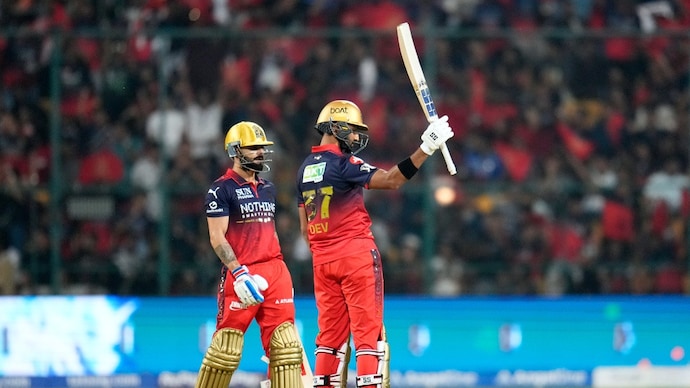
There is a moment, about fourteen seconds long, that I have already rewatched more times than I should admit. Virat Kohli, 55 off 34, surveying Harshal Patel at the top of his mark with the kind of calm that borders on cruelty. What followed was 6, 4, 4, 4. Eighteen runs off four balls to finish a game that was already finished. RCB chased down 202 in 15.4 overs. The fastest 200-plus chase in IPL history. On opening night. At the Chinnaswamy, where the average first-innings score over the last three T20I seasons is 194, where 200 is supposed to be competitive, where teams are supposed to at least sweat a little.
They didn’t sweat. And that sequence, Kohli just casually ending Harshal’s evening, told me more about this IPL season than any pre-tournament preview could.
SRH will not make the playoffs.
Start with the obvious. Sunrisers Hyderabad posted 201/9, which sounds respectable until you examine how they got there and what happened next. Jacob Duffy, a New Zealander making his IPL debut (his actual IPL debut, filling in for the resting Josh Hazlewood), ripped through SRH’s top order in the powerplay: Abhishek Sharma, Travis Head, Nitish Kumar Reddy, all gone. 29 for 3. Duffy’s figures read 3 for 22 in four overs. His post-match quote was perfect:
I am just keeping the big fellow’s seat warm
Jacob Duffy
He was grinning when he said it. He shouldn’t have been that good. That’s the point.
SRH were rescued by Ishan Kishan’s counter-attacking 80 off 38, by Heinrich Klaasen’s steadying 31 off 22, and by Aniket Verma’s extraordinary 43 off 18 (a balls-per-six ratio of 6.67, the third best in IPL history among batters with 20 or more sixes). Verma, specifically, dragged them to a total that should have been enough.
Here’s the structural problem. Pat Cummins is out with a lumbar stress injury, which left Kishan captaining for the first time. No Cummins means no lead quick and no consistent captain. No recognized lead spinner either. Liam Livingstone is a part-timer, not a solution. Harshal Patel and Jaydev Unadkat are experienced, but experience in this format is often not good enough. Eshan Malinga and the spinners were dismantled. When your bowling attack can put up 201 on the board and lose by six wickets with 26 balls remaining, the bowling isn’t thin. It’s transparent. SRH’s group (alongside MI, GT, DC, and LSG) demands consistency. They don’t have the bowling to deliver it.
Kishan, by the way, predicted before the match that SRH and MI would contest the final. Confidence is a beautiful thing. But confidence without a bowling attack is just volume.
The Impact Player rule has broken the balance of T20 cricket, and this match is the evidence.
Devdutt Padikkal walked in as RCB’s Impact Player and smashed 61 off 26 balls. Strike rate: 234.62. His IPL-career-fastest fifty came off 21 deliveries. He brutalised SRH’s spinners, the very bowlers who were supposed to provide control in the middle overs. And here’s what makes it galling for any bowling unit in the league: Padikkal wasn’t even in the starting XI. He was the substitute. The upgrade. The cheat code.
Think about what RCB’s batting lineup looked like with the Impact Player activated: Kohli, Phil Salt, Padikkal, Rajat Patidar (31 off 12 in this match, a cameo that barely registered because everything around it was louder), Tim David, Romario Shepherd. That’s six legitimate power hitters, four of whom are internationals, deployed in a chase. No bowling team in the tournament can plan for that depth. The Impact Player rule was designed to add entertainment. What it’s actually done is hand teams with deep batting stocks (RCB, MI, KKR) an extra weapon while teams relying on bowling balance (GT, SRH) get punished for structural honesty.
If you are a bowling coach in this IPL, I genuinely do not know what you tell your spinners when Padikkal-shaped reinforcements can just appear in the eleventh hour.
RCB’s transformation is real, and the rest of the league has a depth problem it cannot solve mid-season.
Let me put a number on it. RCB have now won three of their last four attempts chasing 200-plus. Before that recent run? They’d won one of their first eighteen such chases in IPL history. One out of eighteen. The defending champions (their maiden title in 2025, and Patidar made sure everyone remembered at the toss: “We are not defending anything, we will win in IPL 2026 as well”) are no longer the franchise that collapses under scoreboard pressure. They are the franchise that chases 202 in 15.4 overs and makes it look like a training drill.
The Kohli-Padikkal partnership is now averaging 71.72 in IPL chases among pairs with 500-plus runs together. That’s the highest in the tournament’s history. Kohli himself finished unbeaten on 69 off 38, his 64th IPL fifty, becoming the first batter to score 6,000 T20 runs and the first to cross 4,000 IPL runs in chases. These are not just milestones. They are evidence that Kohli, at 37, has restructured his T20 game around the chase. He doesn’t need to be the aggressor anymore. He just needs to be there at the end, rotating Padikkal and Patidar and Salt around him like satellites.
And yes, RCB have their own bowling concerns. Yash Dayal is out for the season. Hazlewood just arrived and isn’t match-fit (hence Duffy’s opportunity). Shepherd’s 3 for 54 was useful but expensive. But here’s the difference: their batting depth can outscore their bowling’s mistakes (for now). Not every team has that luxury.
Look across the league. CSK lost Nathan Ellis for the season and lack quality spin depth after Jadeja’s transfer. KKR added Cameron Green and Pathirana, but Harshit Rana is injured and Pathirana is unavailable for the early rounds. GT are light on batting depth in a format that now demands seven capable batters. Multiple contenders have structural flaws that one match, one injury, one bad toss can expose. Pre-season consensus says MI are the most complete squad. PBKS reached the 2025 final with a settled core. KKR’s additions look shrewd on paper. CSK traded for Sanju Samson. Delhi added Aaqib Nabi and Pathum Nissanka. Good moves, all of them. But completeness is relative. The team that just chased 202 in under 16 overs did it without their first-choice overseas quick. The game is evolving and predictions need to be taken with a cubic metre of salt these days.
The IPL’s overseas talent pipeline is deeper than you think, and that changes everything.
Jacob Duffy is 31 years old. He has played four T20Is for New Zealand. He was not supposed to be a story. He was supposed to be a placeholder, a warm body in the XI until Hazlewood was ready. Instead, he produced one of the most impressive debut spells in recent IPL memory and reminded everyone that the global T20 ecosystem now produces match-ready seamers from circuits that barely existed a decade ago. The Big Bash, the SA20, the CPL: these leagues are finishing schools. Duffy arrived polished.
This matters because the IPL’s overseas slots have never been more competitive. Every franchise is three injuries away from needing a Jacob Duffy, and the pipeline now guarantees that the Jacob Duffys of the world are ready. The gap between a team’s first-choice overseas player and their fourth or fifth option has narrowed to almost nothing. That’s a structural shift. It means the teams that win this IPL won’t be the ones with the best starting XIs. They’ll be the ones with the deepest replacement lists.
Phil Salt’s one-handed screamer at point to dismiss Kishan (potential catch of the season, and it’s Day 1) was a reminder of something else: overseas players in 2026 aren’t just here for the batting or to shell out their 24 balls. They’re athletes. Full-spectrum competitors. The IPL used to import power hitters. Now it imports complete cricketers.
So here’s where I land. One match, opening night, 15.4 overs of a chase, and the shape of the season is already visible. RCB are legitimate repeat contenders. SRH’s bowling will sink them before May. The Impact Player rule will keep handing games to batting-heavy rosters. And somewhere, in a domestic league you’re not watching, the next Jacob Duffy is getting ready.
I’ll be here all season. You should be too.