The hairpin. Four laps left. Turn 14 at the Shanghai International Circuit, and the teenager at the front of the Formula 1 world goes deep, brakes late, runs wide. Two seconds gone in a flash. The lead, which had looked so comfortable just a lap before, suddenly felt precarious. The entire paddock held its breath.
Kimi didn’t panic. Almost resembling the Iceman himself.
He gathered the car, reset his lines, and drove the final four laps with the kind of composure that men twice his age spend an entire career searching for. When he crossed the line last week, he didn't just win the Chinese Grand Prix. He won it by five and a half seconds. He was nineteen years old. He is still nineteen.
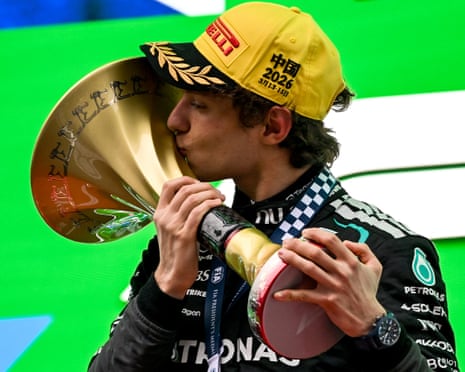
I’m speechless. I’m about to cry, to be honest. Thank you so much to my team, because they helped me to achieve this dream. - Kimi Antonelli
Here’s the question that moment raised two races into the 2026 season which is becoming impossible to avoid: are we watching the beginning of something truly generational, or are we simply dazzled by the speed of a very good young driver in a very good car?
The honest answer, when you look carefully at what this kid has already done and what he has already survived, is that the evidence keeps pointing in one direction. Of course, the argument can be made that we have seen flashy drivers punching well above their weight, until inevitably, they stop. This feels different…
Twelve years before Shanghai, a seven-year-old version of the same kid was being wheeled through the Hockenheim paddock inside a stack of tyres on a trolley, an umbrella balanced on top to hide him from security. His father Marco was racing in the Porsche Supercup that weekend and couldn't get his son a pass. So he improvised. A family friend sorted temporary credentials on the other side, and for one hour, Kimi Antonelli walked the pit lane of a Formula 1 Grand Prix for the first time, chin barely clearing the garage doors, eyes wide open. "We always laugh at the story of the trolley," he said years later. The boy who had to be smuggled in now has a permanent parking space.
Before we talk about who Antonelli is, it helps to understand what he just became.
At 19 years and 202 days old in Shanghai, Antonelli dislodged Sebastian Vettel from the all-time youngest winners list and entered the record books behind only one name: Max Verstappen. He became the youngest pole-sitter in Formula 1 history the day before, eclipsing Vettel’s record by nearly two full years. Then he converted it into a win and the fastest lap of the race, completing a hat-trick that no Italian driver had managed since Alberto Ascari in 1953.
The pole lap itself deserves unpacking. Russell had looked the quicker Merc all weekend, winning the Sprint on Saturday morning and topping every session before qualifying. Then Q3 went sideways. Russell stopped on track with a gearbox issue, limped back stuck in first gear, and his mechanics scrambled to get him out for one final flying lap with two minutes left on the clock. He had no battery, no tyre temperature, and no margin. That should have made Antonelli's pole feel like an inheritance. It did not. Antonelli had already set a 1:32.322 on his first run and, knowing Russell might still come, went out and found another two and a half tenths on his second attempt. A 1:32.064. Two tenths clear.
The last time an Italian stood on the top step of an F1 podium was March 19, 2006, when Giancarlo Fisichella won the Malaysian Grand Prix for Renault. Antonelli was born five months later.
The beginnings
Andrea Kimi Antonelli was born on August 25, 2006, in Bologna, Italy, a city more famous for its food and its university than its racing drivers. His father, Marco, was a racing driver himself, running his own motorsport team out of nearby San Marino. Racing, in the Antonelli household, was simply what the family did.
He started karting at seven. At eleven, after years of dominating junior kart categories across Europe, he was signed to the Mercedes Junior Programme in 2018. The name on the back of his helmet, Kimi, came from a family friend who thought it paired well with Andrea, and not, as many assumed, as a tribute to Kimi Räikkönen (although that would have been a cooler story, given Kimi Räikkönen was the reason I started watching F1) . He chose the number twelve in honour of Ayrton Senna, his idol, and used it through every title-winning campaign in junior racing.
That last detail matters. This is not a driver who stumbled into Formula 1 on the back of family money or nationality quotas. Antonelli is a genuine product of the sport’s development pipeline in its most deliberate fashion: identified early, nurtured carefully, and promoted deliberately. His path from karting to F2 skipped Formula 3 entirely, a decision Mercedes made because they believed he was simply too good for it.
He was eighteen when he made his F1 debut at the 2025 Australian Grand Prix, becoming the third-youngest driver in Formula One history. He passed his driving test six weeks before that race. He was still completing his school exams online through the first half of his rookie season, with racing engineers helping him out.
What 2025 actually built
A lot was written about Antonelli’s rookie season as a story of hype crashing into reality. That reading is wrong. What 2025 actually was, looked at properly, was an accelerated education in what it takes to survive at the front of Formula 1. Although hindsight is 2020, there aren’t many occasions when a rookie driver is put behind the wheels of a top team - Lewis at McLaren might have been the last real example.
He started brilliantly. Fourth on debut in Melbourne’s wet and chaotic conditions, climbing from the back of the grid on intermediate tyres to become the second-youngest points-scorer in F1 history. He backed it up with sixth in China, a Sprint pole in Miami. The paddock was buzzing. The comparisons to Lewis Hamilton’s 2007 debut were flying.
Then came Europe, and the wall.
A difficult car update from Mercedes, combined with the unrelenting media pressure of replacing an all-time great at a top team, began to show. He crashed in FP2 at Monza, his home race, the worst possible place and time. Then he got back in the car and drove so cautiously that his race engineer noticed he was leaving time on the table. Toto Wolff pulled him aside afterwards for a frank debrief.
I even started to doubt myself and I was also afraid that I wouldn’t have been able to get out of it. There was a lot of frustration and I started thinking too much about the final result. - Kimi Antonelli
That level of self-awareness is rare. Most drivers at nineteen, under that kind of scrutiny, deflect or continue to catch the wall. Max Verstappen himself remained a ball of fire until perhaps his fourth or fifth season. Antonelli named the problem precisely. And then he fixed it. He told himself to “reset and start from scratch,” and by Brazil he was racing Lando Norris wheel-to-wheel for the lead of a Grand Prix, finishing second, and becoming the highest-scoring rookie in Formula 1 history (although the points system changing helped him eclipse Hamilton).
The Verstappen comparison
Whenever a prodigiously talented young driver wins his first Formula 1 race, the comparison machine fires up. In Antonelli’s case, the obvious reference point is also the one that hangs above every young driver in this sport: Max Verstappen.
In May 2016, an eighteen-year-old Dutchman was dropped into a Red Bull for his first race with the senior team, one week’s notice, no prior testing in the car, and won the Spanish Grand Prix. He held off a late charge from a very quick Kimi Räikkönen with the measured discipline of a driver twice his age.
Swap the age to nineteen and the words fit Shanghai perfectly. Antonelli, on his first pole position, relinquished the lead to Lewis Hamilton’s rocket start off the line, recovered it within two laps, built a gap through a safety car period, managed his tyres through a closing stint under real pressure, and won.
The differences between the two situations are worth being honest about. Verstappen arrived at Red Bull after twenty-three Grands Prix with Toro Rosso. He had raced in Formula 1 for a year before he sat in a car that could win. Antonelli, by contrast, did his learning entirely in public and at the very front of the field, under the weight of being Lewis Hamilton’s designated successor, in a team that had won constructors’ titles every year from 2014 to 2021. The pressure Verstappen faced in 2016 was significant. The pressure Antonelli has faced since 2025 has been of a different order entirely.
Now, it may take the entirety of these new regulations to fully understand if Antonelli is the real deal or if Toto has just built a jet engine on 4 wheels, but this race does start bringing in the questions to help answering that.
2026 beckons
Two races into the new era, the hierarchy is becoming clear. Mercedes first.
George Russell leads the championship and has been the slightly more consistent force of the two Silver Arrows so far. He won Australia from pole, and claimed the Sprint in China. Beating George will be difficult, but as China showed, it’s not impossible.
What makes this season particularly compelling (aside from these new regulations) is the sharp decline of McLaren).
McLaren (the reigning constructors’ champions, and my favourite team) have not completed a single race lap in 2026. Oscar Piastri crashed on his way to the grid in Australia and was wheeled off in China with electrical failures. Lando Norris isn’t fairing much better. Two rounds in, zero points for the team that won everything last year. Verstappen retired in China after another difficult weekend for Red Bull. Ferrari have pace off the line but not enough on raw speed to challenge over a full race distance.
The championship picture, with all of that context, does not look like a wide-open field. It looks like a Mercedes season. The only question is which Mercedes driver.
Too early to call it a dynasty?
Antonelli has a dominant car. He has a team principal who has publicly called him world champion material. He has a race engineer in Peter Bonnington, the same man who guided Hamilton through a decade of titles, who knows what it takes to build a champion. And in two Grands Prix, on his first pole position and in his first race win, he has shown the composure and the intelligence of a driver who already knows what he is doing at the very front of this sport. But, many, like Oscar Piastri last season, may start off incredibly hot but the wick begins to wither away as the season progresses. What will happen to Antonelli is a question we will only find out closer to the end of the season.
Even Luca di Montezemolo, the former Ferrari president, could not resist the subtext after Shanghai. "His victory thrilled me," he told Corriere della Sera, before admitting what many in Italy were thinking: "It was a bit annoying to see him in a Mercedes. I would have preferred him in [a] Ferrari." Then the qualifier, the one that reveals the depth of the dilemma: "Putting someone like him directly into Ferrari would have meant destroying him." He is probably right. The weight of being an Italian teenager racing for Ferrari, carrying the expectations of the tifosi and the Scuderia simultaneously, might have been too much, too soon. But that is exactly the kind of pressure Mercedes shielded him from, and it is exactly the kind of freedom that allowed him to crash at Monza, rebuild in silence, and arrive in Shanghai as a race winner rather than a cautionary tale. Ferrari's loss, in the end, may have been Antonelli's gain.
Toto Wolff, asked in the Shanghai parc fermé whether this win had come earlier than expected, paused before answering. “The win has maybe come earlier than I thought,” he said. Then he looked at the podium (Antonelli, Russell, Hamilton).
Three men at three different stages of their careers. The one at the top, holding the trophy, was born five months after the last time an Italian held one.
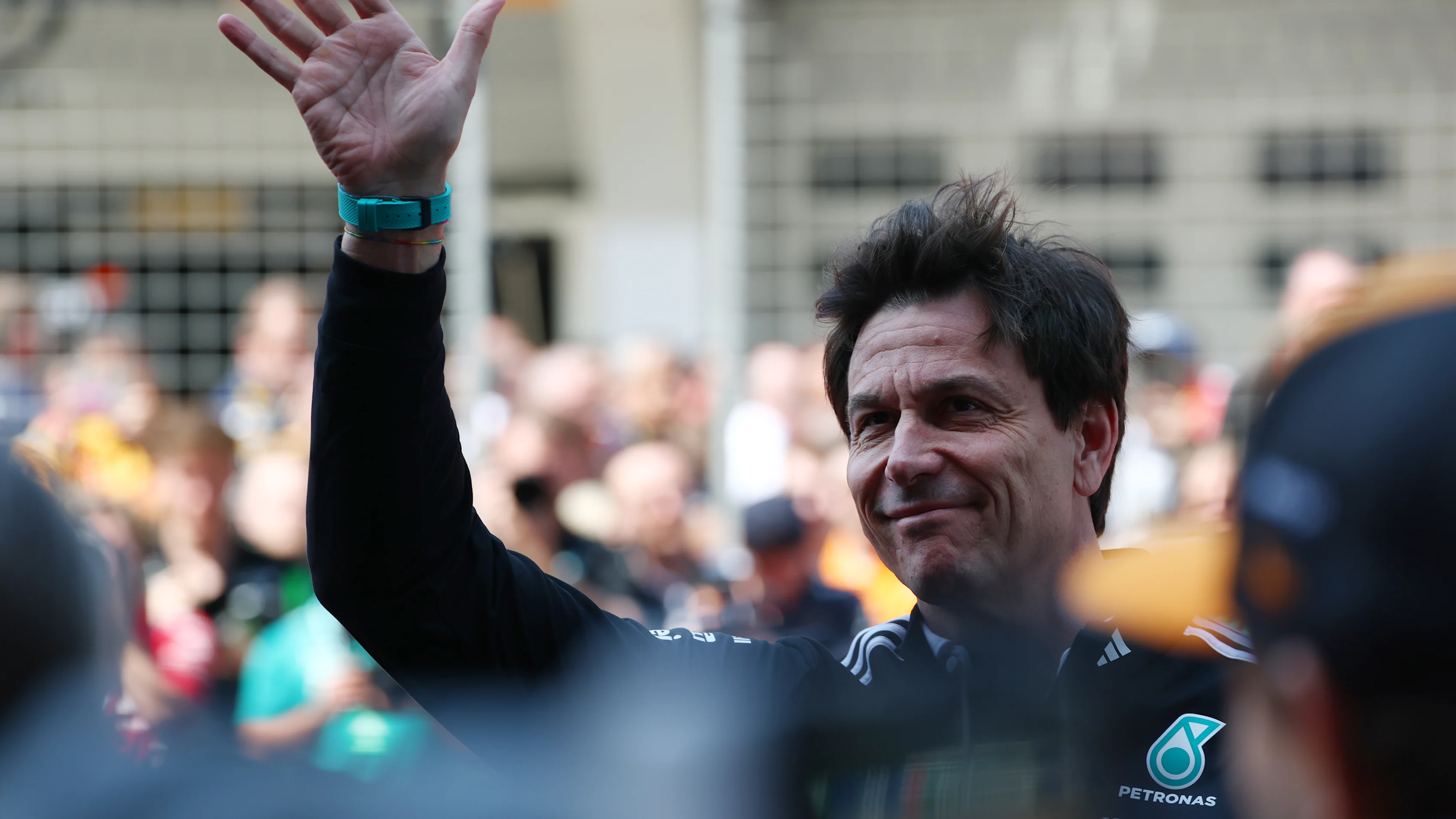
He will make mistakes. He will have great days like today. And all of that is going to add to hopefully being a World Champion one day. - Toto Wolff, Shanghai
One day. Perhaps. But in Shanghai, with the crowd still roaring and the Italian national anthem filling the circuit for the first time in twenty years, the future did not feel like something distant. It felt like something that had already arrived.